

I’ve tested dozens of grills and narrowed the field to the ten that really deliver for 2025–2026, focusing on fuel type, build materials, heat control and real-world performance. I’ll walk you through standout models from compact built-ins to versatile charcoal and pellet smokers, point out who each suits best, and flag common tradeoffs—so you can pick the right setup for your yard and budget. Keep going to find the grill that fits your cooking style.
Key takeaways
- Prioritize grill type (gas, charcoal, pellet, electric) based on flavor, convenience, and backyard setup.
- Evaluate construction materials (304 stainless, porcelain-enameled steel) for corrosion resistance and long-term durability.
- Compare cooking capacity and burner/grate specs—look for 508 sq in surfaces or 3-burner setups for family and entertaining.
- Check ignition, hardware, and cleanup features (flame-thrower ignition, One-Touch ash system, soft-close doors, wheels).
- Match warranty and installation needs: lifetime residential coverage for built-ins and clear cutout/weight requirements for built-in grills.
Blaze Outdoor Kitchen 25-inch Built-in Propane 3-Burner Grill (Prelude LBM BLZ-3LBM-LP)
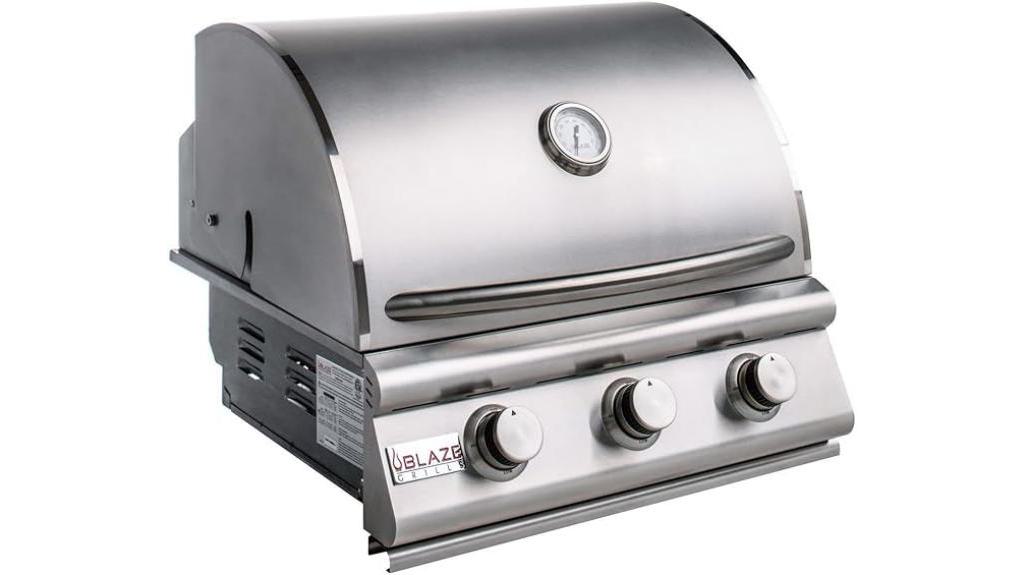
If you want a built-in grill that feels as tough as a pro setup, I recommend the Blaze 25-inch Prelude LBM — it pairs commercial-grade 304 stainless construction with three precision 16-gauge burners so you’ll get consistent heat and long-lasting corrosion resistance for heavy backyard use. I’ve found its 8 mm stainless cooking rods and engineered components deliver even searing and easy cleanup. It fits a 23 1/4″ x 21 1/4″ cutout, weighs 88 pounds, and measures 25″ wide overall. Backed by a lifetime residential warranty (plus a three-year commercial option), it’s a durable, no-nonsense choice for built-in installs.
Best For: Homeowners seeking a heavy-duty, built-in propane grill that offers commercial-grade durability and consistent heat for serious backyard cooking.
Pros:
- 304 stainless steel construction and 16-gauge burners provide excellent corrosion resistance and long-term durability.
- Three precision burners and 8 mm stainless cooking rods deliver even searing and consistent heat distribution.
- Lifetime residential warranty (with a 3-year commercial option) offers strong long-term protection.
Cons:
- Narrow 25-inch overall width may limit cooking surface compared with larger grills.
- At 88 lbs, installation requires sturdy support and may need assistance to fit the cutout.
- Built-in design requires precise 23 1/4″ x 21 1/4″ cutout, reducing flexibility for placement or future relocation.
Blaze Outdoor Kitchen 25-inch 3-Burner Propane Gas Grill
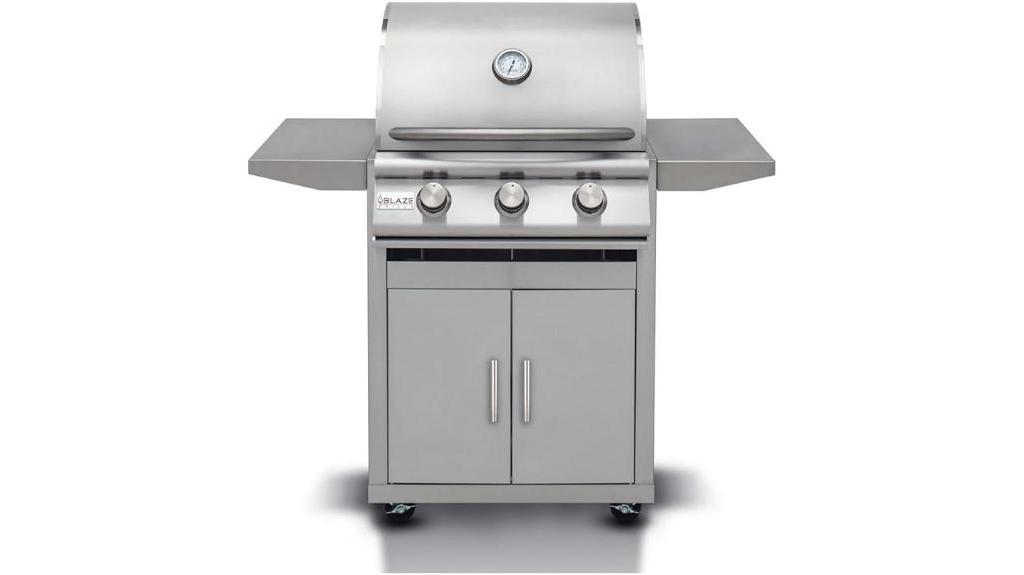
I think the Blaze Outdoor Kitchen 25-inch 3-Burner Propane Gas Grill is a smart pick for homeowners who want commercial-grade performance without upgrading to a full outdoor kitchen. I’ve used the Prelude LBM model and appreciate its 304 stainless steel build, 16-gauge tube burners, and 8 mm cooking rods that deliver even heat and resist corrosion. The Push & Turn flame-thrower ignition lights reliably, and the stainless cart with soft-close doors feels sturdy. It’s value-oriented but feels premium, backed by a lifetime residential warranty and a 3-year commercial option—solid for patio cooks who want longevity and consistent results.
Best For: Homeowners who want commercial-grade grilling performance and durability on a patio without committing to a full outdoor kitchen.
Pros:
- Durable 304 stainless steel construction and corrosion-resistant components for long-term outdoor use.
- Even heat and reliable performance from three 16‑gauge stainless steel tube burners and 8 mm cooking rods.
- Quick, dependable Push & Turn flame-thrower ignition and a sturdy stainless cart with soft-close doors.
Cons:
- 25-inch width may be small for users who regularly cook for large groups or need extensive cooking surface.
- Propane-only design may not suit those who prefer natural gas hookups without conversion.
- Value-oriented model may lack some high-end extras/features found on larger premium grills.
Weber Master-Touch Charcoal Grill and Smoker, 26-Inch, Black
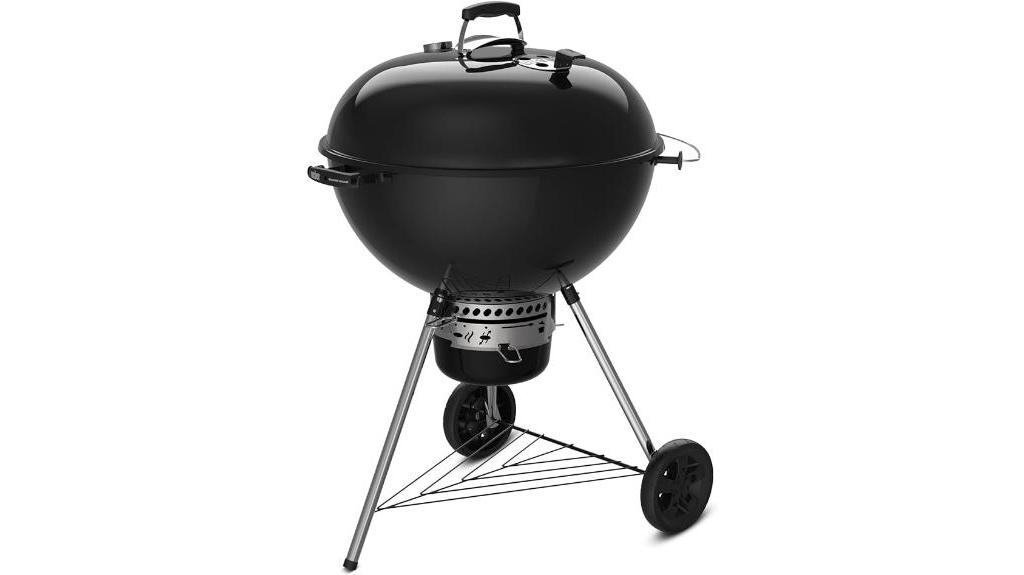
You’ll appreciate the Weber Master-Touch if you want a durable, versatile charcoal grill that’s easy to control for both searing and low-and-slow smoking. I like the porcelain-enameled lid and bowl — they resist rust, hold heat, and tolerate high temps. The hinged Weber Crafted stainless-steel cooking grate feels solid for frequent use. Charcoal rails let me set up direct sear zones or indirect smoking, while the bottom-damper smoke setting and built-in lid thermometer simplify airflow and temp control. Cleanup’s easier with the One-Touch ash system and Tuck-Away lid holder, and 8-inch wheels make it portable.
Best For: Home cooks and backyard grillers who want a durable, versatile charcoal grill that’s easy to control for both high-heat searing and low-and-slow smoking.
Pros:
- Porcelain-enameled lid and bowl resist rust, retain heat, and withstand high temperatures for long-lasting performance.
- Hinged stainless-steel Weber Crafted cooking grate plus charcoal rails and bottom-damper setting allow precise control for searing or indirect smoking.
- One-Touch ash system, Tuck-Away lid holder, and 8-inch wheels make cleanup and mobility convenient.
Cons:
- Charcoal grills require more hands-on fuel and temperature management compared with gas or pellet grills.
- Heavier, sturdier construction can make it less convenient to move frequently despite the wheels.
- No built-in fuel hopper or automatic temperature control for fully unattended long smoking sessions.
Weber Master Touch Charcoal Grill 26″
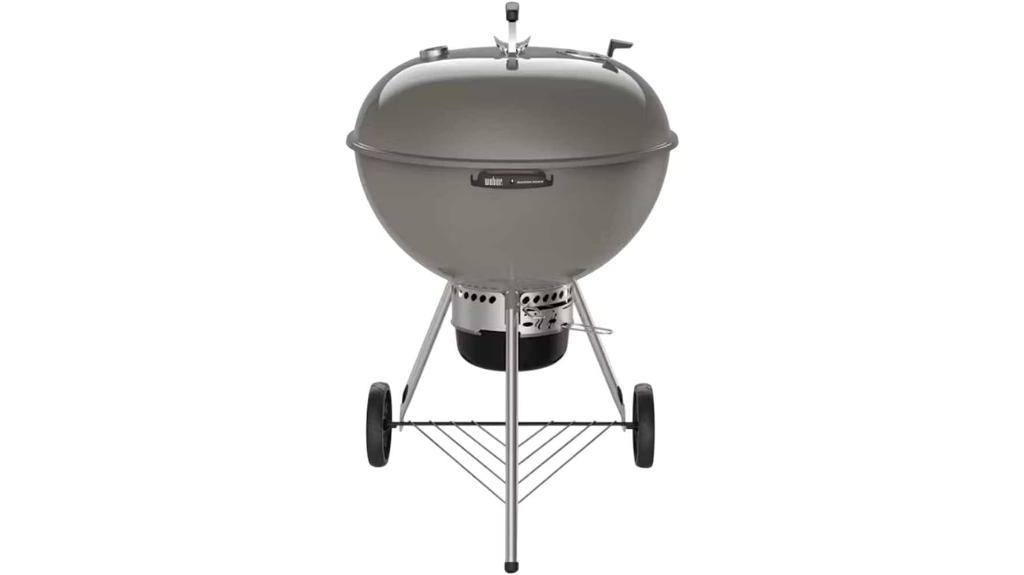
For backyard cooks who love charcoal flavor but want versatile cooking options, I recommend the Weber Master-Touch 26” for its multi-level, WEBER CRAFTED-ready grate that converts the classic kettle into a griddle, pizza oven, or searing station. I weigh its 508 sq in cooking surface, sturdy stainless-steel grate, and porcelain-enameled lid as ideal for both direct grilling and low-and-slow smoking. The One-Touch ash system and built-in thermometer simplify cleanup and temperature control. At about 71.4 pounds with a glazed metal frame and tool holder, it’s a durable, freestanding charcoal workhorse backed by Weber support.
Best For: backyard cooks who want authentic charcoal flavor with flexible, multi-level cooking options for grilling, searing, griddling, and low-and-slow smoking.
Pros:
- Large 508 sq in stainless-steel cooking surface with WEBER CRAFTED removable center for griddle, pizza oven, and searing accessories.
- Porcelain-enameled lid and bowl plus One-Touch ash system and built-in thermometer for reliable heat retention, easy cleanup, and temperature control.
- Durable freestanding metal frame with tool holder and manufacturer support—well-suited for a range of outdoor cooking styles.
Cons:
- At 71.4 pounds assembly required and limited portability compared with compact grills.
- Accessories for WEBER CRAFTED center (griddle, pizza oven, etc.) sold separately, adding to total cost.
- Single-charcoal heating configuration means no independent burners or precise multi-zone gas-style control.
BBQ Chef Christmas Tree Ornament (Round Ceramic)

If you’re shopping for a thoughtful gift or a keepsake that celebrates a grill master, I recommend the BBQ Chef Christmas Tree Ornament — a compact, glossy 3-inch ceramic disk that proclaims “Worlds Best BBQ Chef.” I like its solid one-piece ceramic construction (0.125-inch thick) and UV-printed, fade-resistant wording. It ships with a gold-toned hanging string and works indoors or outdoors: trees, wreaths, patios, offices, or wrapped gifts. It’s lightweight yet sturdy, suitable for any age or gender, and cleans with a dry microfiber cloth. Check manufacturer warranty and availability; feedback options help report lower prices.
Best For: A thoughtful gift or keepsake for grill masters, pitmasters, and anyone who loves BBQ, suitable for decorating Christmas trees, wreaths, patios, or workspaces.
Pros:
- Compact, glossy 3-inch ceramic ornament with durable one-piece construction (0.125 in) and UV-printed, fade-resistant “Worlds Best BBQ Chef” design.
- Includes a gold-toned hanging string and is lightweight yet sturdy for indoor or outdoor display (trees, wreaths, wreaths, patios, offices).
- Easy care—wipe gently with a dry microfiber cloth—and versatile as a gift for all ages and genders.
Cons:
- One-sided print only, so the reverse is blank and may not be visible from all angles.
- Ceramic can still break if dropped or knocked against hard surfaces despite sturdy construction.
- Limited size (3 inches) may be too small for those wanting a more prominent decoration.
Santa’s Favorite Barbecue Cook Ceramic Ornament for Grill Master (Round)
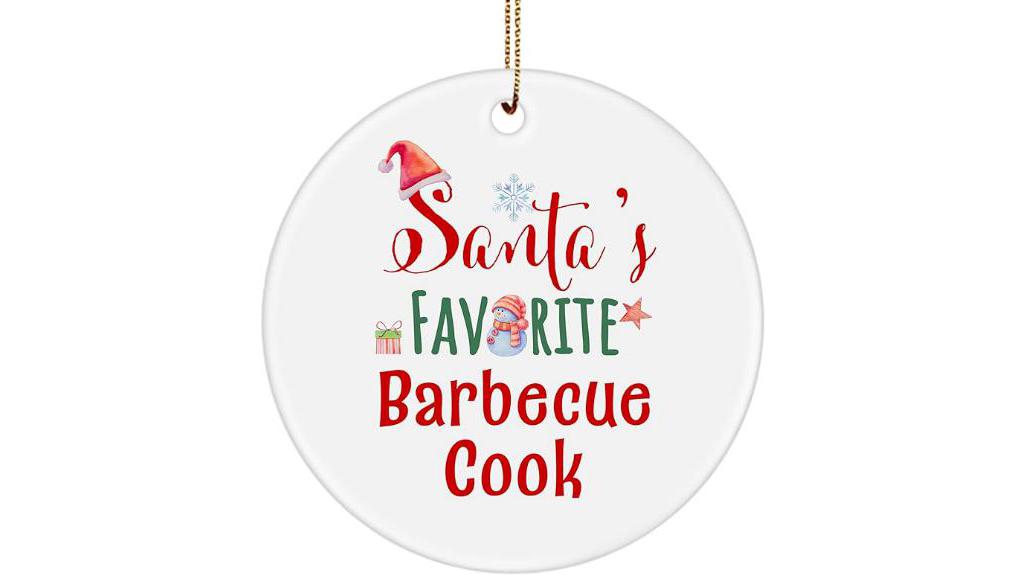
I always recommend the Santa’s Favorite Barbecue Cook ceramic ornament for anyone who regularly mans the grill and loves a bit of holiday humor—its bold, festive text and compact 3-inch round design make it a perfect keepsake for grill masters, pitmasters, and barbecue-loving friends. I like that it’s premium ceramic yet lightweight, so it hangs securely without weighing down branches. It arrives in ready-to-gift packaging with a sturdy string, making gifting effortless. Durable enough to last seasons, it adds personality to trees, wreaths, or party decor and makes a thoughtful, humorous hostess or office gift for 2024–2026.
Best For: Grill masters, barbecue-loving friends or office colleagues who enjoy humorous, festive keepsakes and holiday hostess gifts.
Pros:
- Premium ceramic yet lightweight 3-inch round design that hangs securely without weighing down branches.
- Bold, vibrant holiday text and humorous theme that adds personality to trees, wreaths, or party decor.
- Arrives in ready-to-gift packaging with a sturdy string and is durable enough to last multiple holiday seasons (2024–2026).
Cons:
- Small 3-inch size may be easy to misplace or less visible on large trees.
- Ceramic material, while durable, can break if dropped or handled roughly.
- Specific humor/theme aimed at grill enthusiasts may not appeal to recipients who don’t barbecue.
Santa’s Favorite Barbecue Cook Christmas Ornament (Round Ceramic)

I’m calling out this Santa’s Favorite Barbecue Cook ornament for anyone who often finds themselves grilling through the holidays—it’s a 3-inch, round ceramic keepsake that uses UV-printed colors so it won’t fade even after years of festive use. I love its funny, festive Santa-and-barbecue theme; it’s perfect for a grill master, pitmaster, or coworker who lives for smoke and sauce. The durable ceramic feels substantial, and the ornament comes in a white gift box with a lid, ready to gift. Hang it on the tree, prop it on a desk, or pack it as a heartfelt holiday keepsake.
Best For: Grill masters, pitmasters, or anyone who loves BBQ and wants a funny, festive ornament to celebrate holiday grilling.
Pros:
- Durable 3-inch ceramic with UV-printed design that resists fading for long-lasting color.
- Funny Santa-and-barbecue theme makes a playful, thoughtful gift for grill enthusiasts.
- Comes packaged in a white gift box with lid, ready to present.
Cons:
- Small size (3-inch) may be less visible on large trees or displays.
- Ceramic can chip or break if dropped or handled roughly.
- Design is niche—may not appeal to recipients who don’t grill or enjoy BBQ humor.
My First Christmas as a Grill Cook 2025 Ceramic Ornament (3-Inch Round)
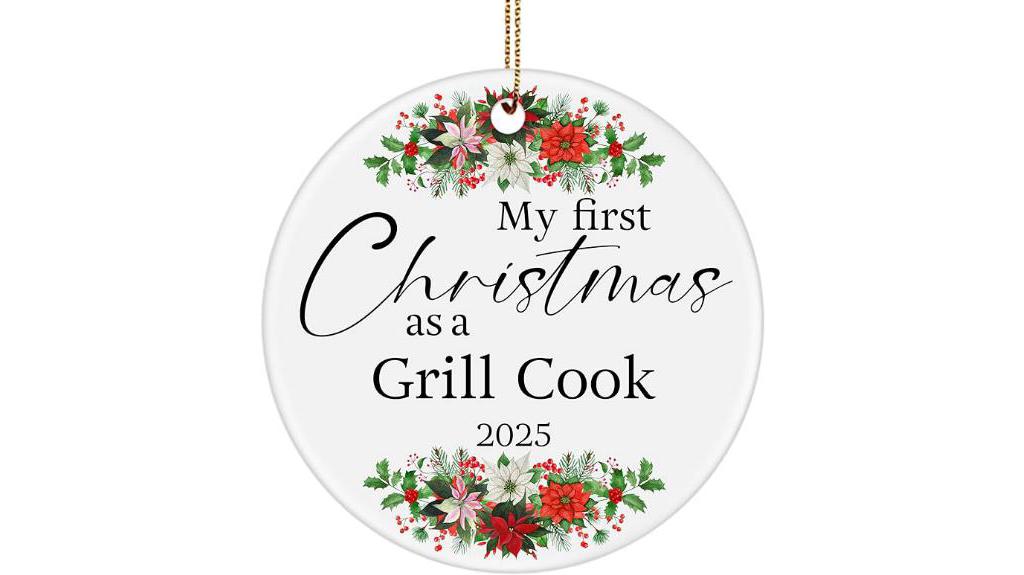
As someone who’s built grills and waited tables, I know this 3-inch round “My First Christmas as a Grill Cook 2025” ceramic ornament is perfect for anyone stepping into their first head-cook role or celebrating a new barbecue job. I bought one as a keepsake for a friend who just landed a grill cook position, and the premium ceramic feels solid without being bulky. The heartfelt message marks a real milestone, and the pre-attached string made hanging it effortless on a tree or wreath. It arrives in a gift-ready box with a clear lid, so you can present it immediately.
Best For: new grill cooks, barbecue chefs, or anyone celebrating their first year as a head cook who wants a meaningful holiday keepsake.
Pros:
- Premium 3-inch ceramic feels sturdy and looks high-quality for long-term display.
- Comes in a gift-ready box with a clear lid, perfect for immediate gifting.
- Pre-attached string makes hanging on a tree or wreath quick and easy.
Cons:
- Specifically dated to 2025, limiting long-term relevance after the year passes.
- Small 3-inch size may be less impactful on large trees or displays.
- Ceramic can chip if not handled or stored carefully.
My First Christmas as a Barbecue Cook 2025 Ceramic Ornament (3-Inch Round)
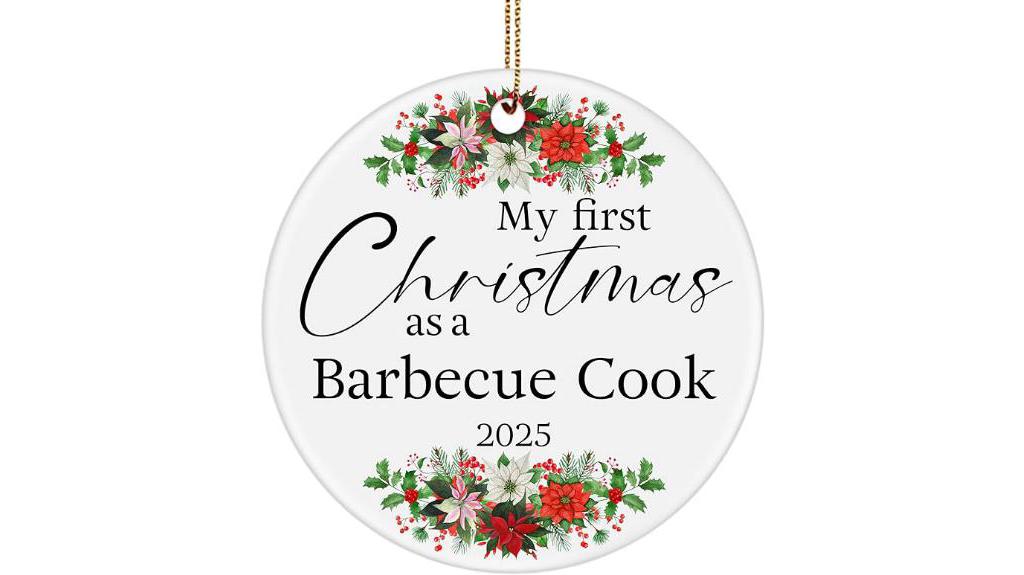
You’ll love this 3-inch ceramic ornament if you’ve just stepped into the world of smoking and grilling—it’s made to celebrate a first Christmas as a barbecue cook or a newly promoted grill master. I bought this premium ceramic, durable 3-inch round keepsake to mark my milestone year; the heartfelt quote, “My First Christmas as a Barbecue Cook 2025,” feels personal. It’s lightweight with a sturdy hanging string, perfect for trees, wreaths, or party displays. It arrived in a gift-ready box with a transparent lid, so I could present it immediately. It’s a tidy, sentimental memento for 2025 and the new year ahead.
Best For: anyone celebrating their first Christmas as a barbecue cook, newly promoted grill master, or someone who wants a profession-themed keepsake for 2025.
Pros:
- Premium ceramic, durable 3-inch round keepsake with a heartfelt quote that marks the milestone year.
- Lightweight with a sturdy pre-attached hanging string—easy to display on trees, wreaths, or party decor.
- Arrives in a gift-ready box with a transparent lid for immediate presentation and long-term sentimental storage.
Cons:
- Small 3-inch size may be easy to misplace among other ornaments or decorations.
- Ceramic construction, while durable, can still chip or break if dropped or handled roughly.
- Specific 2025 wording limits long-term relevance for those who prefer more timeless designs.
3 Year Pocket Calendar Planner with Free Note Pad, Interests & Seasonal (Summer Grill, 2025-2027)

I recommend this compact 3‑year pocket planner for grill owners who juggle weekend cookouts, seasonal recipes, and guest lists—its Summer Grill theme and three full years (2025–2027) help you plan peak grilling seasons at a glance. I like the 6 7/8″ × 3 3/4″ closed size and slim 3/8″ profile that slip into pockets or aprons. It opens to a readable 6 7/8″ × 7 1/2″ layout with weeks starting Sunday and four pages for contacts, passwords, and birthdays. The 30‑page notepad (3″×6.5″), vinyl cover, printed insert, and USA manufacture make it practical and durable.
Best For: Grill owners and weekend hosts who need a compact, year‑round planner to schedule cookouts, seasonal recipes, and guest lists.
Pros:
- Compact, slim 6 7/8″ × 3 3/4″ size that fits pockets or aprons and opens to a readable layout.
- Covers three full years (2025–2027) with weeks starting Sunday and dedicated pages for contacts, passwords, and birthdays.
- Comes with a free 30‑page notepad, flexible vinyl cover, quality printed insert, and is made in the USA.
Cons:
- Vinyl (not leather) cover may feel less premium to some users.
- Small pocket format limits writing space on individual date blocks.
- Themed Summer Grill design may not appeal to users seeking a neutral or professional look.
Factors to Consider When Choosing BBQ Grills 2025 – 2026
When I’m choosing a grill for 2025–2026, I first think about fuel type and what works best for my cooking style. I also check build quality, cooking power, surface area, and how precisely I can control temperature. Those factors tell me whether a grill will perform reliably and suit my needs.
Fuel Type & Preference
I’ll walk you through how fuel choice shapes what a grill can do, because the type of fuel largely determines heat range, flavor, convenience, and maintenance. I prefer matching fuel to cooking goals: propane or natural gas gives fast, controllable heat—500–600°F quickly—for searing and precise temps. Charcoal delivers higher peak sear and authentic smoky flavor but needs 20–40 minutes to heat and more active ash and fuel management. Pellet grills use an electric auger and digital controls to hold steady low-and-slow temps (about 180–500°F), ideal for smoking and indirect cooking. Electric grills are simple for flame-restricted spaces—consistent heat without fuel handling but limited sear and smoke. Hybrids combine gas speed with charcoal or wood smoke for flexibility, at the cost of complexity.
Build Materials Quality
Check the build materials before you buy—what a grill’s made of determines how long it lasts, how well it holds heat, and how much care it’ll need. I always favor 304 (18/8) stainless for bodies, burners, and grates because it resists corrosion and handles heat far better than lower grades. Thickness matters: look for 16–14 gauge (about 1.5–2.0 mm) stainless or heavy aluminized steel to resist warping and reduce heat loss. Solid grates—8 mm+ stainless rods or cast stainless/iron—give even heat and longevity compared with thin chrome plating. Prefer burners made from 16-gauge or heavier stainless tubing with welded ports over stamped types. Finally, check for fully welded seams, TIG or continuous welds, and powder-coat or marine-grade finishes on non-stainless parts to minimize rust.
Cooking Power Output
Because cooking power’s about more than peak BTUs, I focus on how a grill converts fuel into usable, controllable heat. I check total BTU or kW ratings as a baseline, but I also compare heat distribution metrics like BTU per square inch so heat’s even across the grate instead of concentrated. I weigh burner types and materials—tube, cast-iron, ceramic—since design and alloy influence efficiency. With charcoal or pellet units I assess charcoal capacity or pellet feed rate (lb/hr) plus draft and vent control, because burn rate and airflow determine sustained searing power versus low-and-slow performance. Finally, I match peak output to searing needs while verifying a grill’s low-output range and temperature stability over time.
Cooking Surface Area
When I choose a grill I start with cooking surface area, since square inches tell you how much you can cook at once and shape how you’ll actually use the cooker. I look at the primary grate size—500+ sq in handles whole birds and multiple steaks; under 300 sq in fits couples. I also count secondary surfaces like warming racks, which add about 20–30% usable area and give flexibility for indirect cooking. I plan roughly 50–75 sq in per person for mixed grilling to avoid overcrowding. I check grate design too: thick rods or wide spacing reduce true contact and alter heat distribution despite high nominal area. Finally, I favor modular or multi-level surfaces so capacity can grow without taking more storage space.
Temperature Control Precision
Although temperature reads feel simple, I prioritize precision because it determines what I can cook and how consistently it turns out. I look for grills with adjustable burner zones or multiple independent burners so I can create 50–100°F differentials across the surface—perfect for searing while maintaining low-and-slow areas. Built-in calibrated thermometers and integrated probe ports, or included probe-style thermometers reading to ±2–3°F, beat vague dial gauges. Materials and lid design matter: heavy-gauge stainless or cast-iron lids with tight seals cut temperature swings during long cooks. For intense searing I value infrared or direct-contact burners that exceed 900°F, paired with convection zones holding 225–300°F. When available, PID or electronic controllers give the tightest hold, often within ±1–5°F.
Portability & Size
I factor portability and size into every grill choice because where and how you’ll use it shapes everything from cook time to safety. I measure available space—patio, balcony, tailgate—and pick dimensions that leave 12–18 inches clearance on all sides for airflow and safe operation. For true portability I prefer grills under 60–70 pounds with handles and locking lids; tabletop or backpackable models at 10–30 pounds work for solo transport. I check folded or disassembled dimensions so it fits trunks, closets, or overhead racks. I account for fuel capacity and added weight: 1-lb canisters trade run time for easier carrying, while 20-lb tanks weigh more. Finally, I balance grate area—200–300 sq in for travel, 400+ sq in if transport isn’t a priority.
Warranty & Support
Because a grill’s warranty and support determine how long your investment really lasts, I always read the fine print before buying. I check length and scope—lifetime coverage on burners or stainless bodies vs limited parts-and-labor—so I know what’s protected long-term. I verify residential vs commercial distinctions because rental or multi-user situations often need a different, shorter policy. I confirm voiding actions: improper installation, incompatible fuel, unauthorized mods, skipped maintenance, or corrosive cleaners. I review support channels—phone, email, live chat—and documented troubleshooting and parts availability to speed repairs. Finally, I ask about the claims process: required documentation, authorized-service centers, typical part turnaround, and whether they offer in-home service or require returns to the factory.
FAQs
Can These Grills Be Used Safely on Apartment Balconies?
Yes — I can’t guarantee safety, but I don’t recommend most gas or charcoal grills on apartment balconies; check your lease and local fire codes, use approved electric or small propane units, and keep clearances and extinguishers handy.
How Do Local Emissions Regulations Affect Grill Choice?
They matter a lot: I check local emissions rules before buying, and I’ll choose electric or low-emission propane models where restrictions exist, register compliant grills if required, and avoid charcoal when bans or strict limits apply.
Can I Convert Propane Grills to Natural Gas Myself?
You can sometimes convert a propane grill to natural gas, but I wouldn’t recommend doing it myself unless I’m certified; it needs the correct conversion kit, regulator, and leak-tested connections for safety and code compliance.
What Warranty Steps Are Needed After a Purchase Overseas?
You’ll need proof of purchase, register the grill with the manufacturer, confirm international warranty coverage, get serial/model numbers, keep repair receipts, arrange authorized service or return shipping, and I’ll help contact support if you want.
Are Any Grills Compatible With Smart Home Assistants?
Yes — I’ve found several grills that work with smart home assistants; I’ll connect models with Wi‑Fi or Bluetooth to Alexa or Google, enable their skill or app, then link accounts so voice commands and monitoring work seamlessly.
Conclusion
I’ve taken you through top grills, from compact 25″ stainless gas builders to classic 26″ Weber charcoal kettles and versatile pellet smokers, weighing materials, burners, grates, heat control and warranties. Now it’s your call: match the grill’s fuel type, build quality and surface to how you cook, how often, and your budget. Pick durability if you want long-term value, choose features for convenience, and prioritize flavor if charcoal or wood-smoke matters most.